

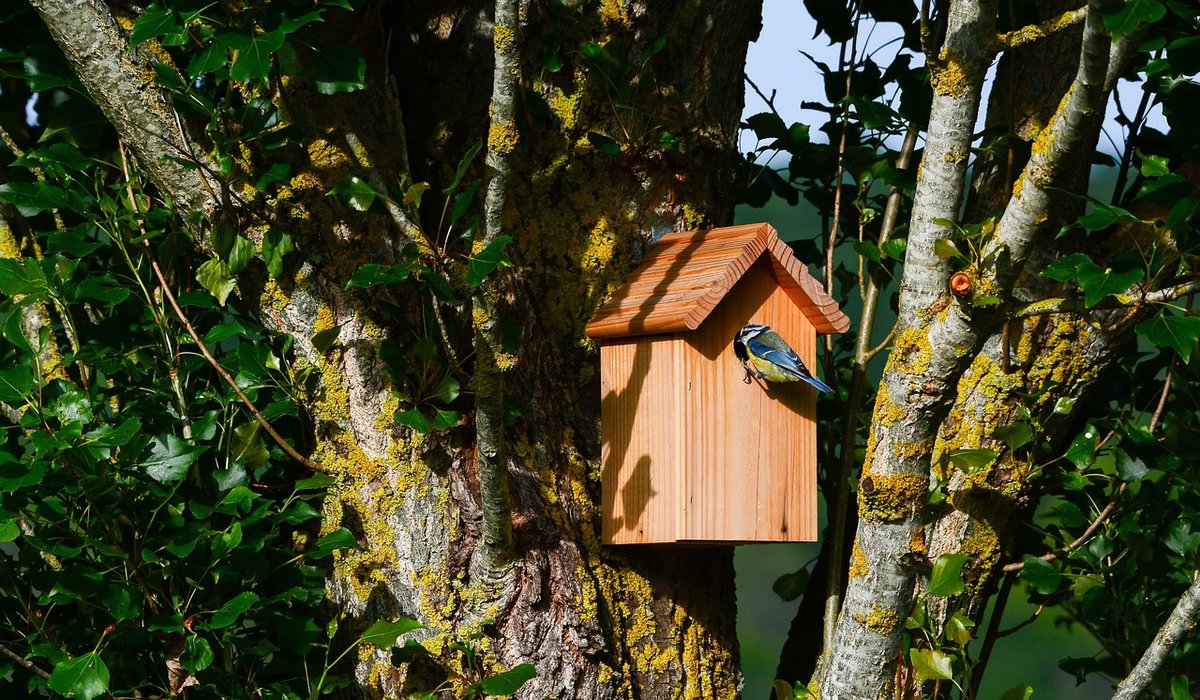
Why cats target your feeders
Anyone who feeds the birds will eventually notice a cat sitting beneath the feeder, tail twitching, waiting with the patience of a creature who knows the buffet opens at dawn. It is not malice on the cat's part — it is simply hunting behaviour, and a bird table is one of the easiest hunting grounds in Britain. A feeder concentrates prey in one predictable spot, often at a height a cat can reach with a single leap from a fence, wall or shed roof.
The good news is that deterrence is mostly about geometry. If you remove the ambush points and make the approach uncomfortable, most cats will give up and go back to patrolling the flower beds. You do not need to harm them, and you should never try to. A few thoughtful adjustments will do far more than any scare tactic.
Get the height and distance right
The single most effective change is to move the feeder further from anything a cat can launch itself off. Cats are impressive jumpers, but they are not built for long, flat take-offs. They need an elevated platform close by so they can spring upwards and forwards.
- Height: aim for a feeder that sits around 1.8 metres (roughly 6 feet) from the ground, or higher if your local cats are particularly athletic.
- Distance from launch pads: keep at least 2 metres of clear air between the feeder and the nearest fence, wall, tree branch or shed roof. Three metres is better still.
- Ground clearance: make sure the lowest feeding port is well above a cat's standing reach — around 1.5 metres minimum — so they cannot simply stretch up and swipe.
If your garden is small and a 2-metre gap is impossible, consider a feeder on a tall, smooth metal pole placed in the most open part of the lawn. Open ground makes cats feel exposed, and they dislike that more than you might expect.
Fit a baffle or a cat-proof pole
Where height alone is not enough, a baffle is your best friend. These are the cone-shaped or dome-shaped guards that slide onto a pole below the feeder. The principle is simple: a cat cannot climb a pole it cannot grip, and it cannot get past a wide, slippery cone that wobbles under its weight.
- Baffle size: choose one with a diameter of at least 40cm, and wider if you can find it. A cat needs something substantial to wrap its paws around.
- Position: mount it roughly 60–90cm below the feeder, and high enough that the cat cannot leap over the top of it from the ground.
- Stability: a baffle that sways or tilts slightly is more effective than a rigid one, as it gives the cat nothing to push against.
- Pole choice: smooth, narrow metal is much harder to climb than wood, and a squirrel baffle often doubles up nicely as a cat deterrent.
If your feeder hangs from a branch or bracket, a baffle above it will not help. In that case, move the hanging point out along a wire or a smooth arm so there is no route in from above, and keep the branch itself well clear of fences.
Plant a prickly border underneath
Beneath the feeder is where the real action happens, because that is where the spilt seed falls and where the ground-feeding birds — dunnocks, robins, blackbirds — spend their time. A cat lying in wait under the feeder is a serious problem, and soft lawn offers it a comfortable hiding place.
Planting a dense, prickly barrier around the base changes that calculation immediately. Good options for British gardens include:
- Holly and pyracantha, both of which are dense, evergreen and thoroughly unpleasant to push through.
- Berberis and mahonia, which have sharp spines and cope well with most soils.
- Rosa rugosa or a thorny climbing rose, trained low along a boundary.
- Gorse or blackthorn in larger gardens, though both need space.
Underplant around the feeder in a rough ring, leaving a clear central area for the birds to land. The idea is not to trap the birds, but to make the ground beneath the feeder an unappealing place to crouch. Sharp gravel or large, uneven cobbles work well too, as cats dislike walking on unstable surfaces.
Remove cover and clear the ground
Cats rely on stealth. Take away the hiding places and you remove most of the advantage. A few minutes of tidying can make a surprising difference.
- Cut back long grass, nettles and overgrown borders near the feeder so nothing provides a low screen.
- Move log piles, plant pots and garden furniture away from the feeding area, as these all make handy stalking platforms.
- Clear spilt seed regularly so ground-feeding birds are not drawn into a predictable, exposed spot. A tray or a seed catcher under the feeder reduces waste and keeps birds off the lawn.
- Trim low shrubs so they have a clear stem of at least 60cm — birds can still use them for cover, but cats lose the low tangle they like to slink through.
If a neighbour's cat is a persistent visitor, a motion-activated water sprayer positioned near the feeder can be very effective. It is harmless, startling and does not require you to be watching from the window.
Make your garden less inviting overall
Sometimes the most reliable solution is to reduce the cat's reasons for being in your garden at all. Cats are creatures of habit, and disruption to their routine is often enough to send them elsewhere.
Keep a section of the garden as a wilder, denser area well away from the feeders — a hedgerow corner or a small wildlife patch. Cats will naturally gravitate to the cover there, and the birds will soon learn to feed in the open space you have kept clear. Scent deterrents derived from citrus, lavender or certain plant oils can help when reapplied regularly along boundaries, though they work best as part of a wider plan rather than on their own.
Finally, be patient and consistent. Birds adapt quickly to a new feeder layout, often within a few days. Cats take a little longer, but once the easy ambush is gone, most will simply stop coming. A feeder high in the open, with prickly planting below and no launch pad within leaping distance, is a feeder that both you and your garden birds can relax around.


Coding is used in almost all aspects of life and work now, be it directly or indirectly. It’s not just for companies in the tech sector. “An increasing number of businesses rely on computer code,
Coding is used in almost all aspects of life and work now, be it directly or indirectly. It’s not just for companies in the tech sector. “An increasing number of businesses rely on computer code,
Coding is used in almost all aspects of life and work now, be it directly or indirectly. It’s not just for companies in the tech sector. “An increasing number of businesses rely on computer code,